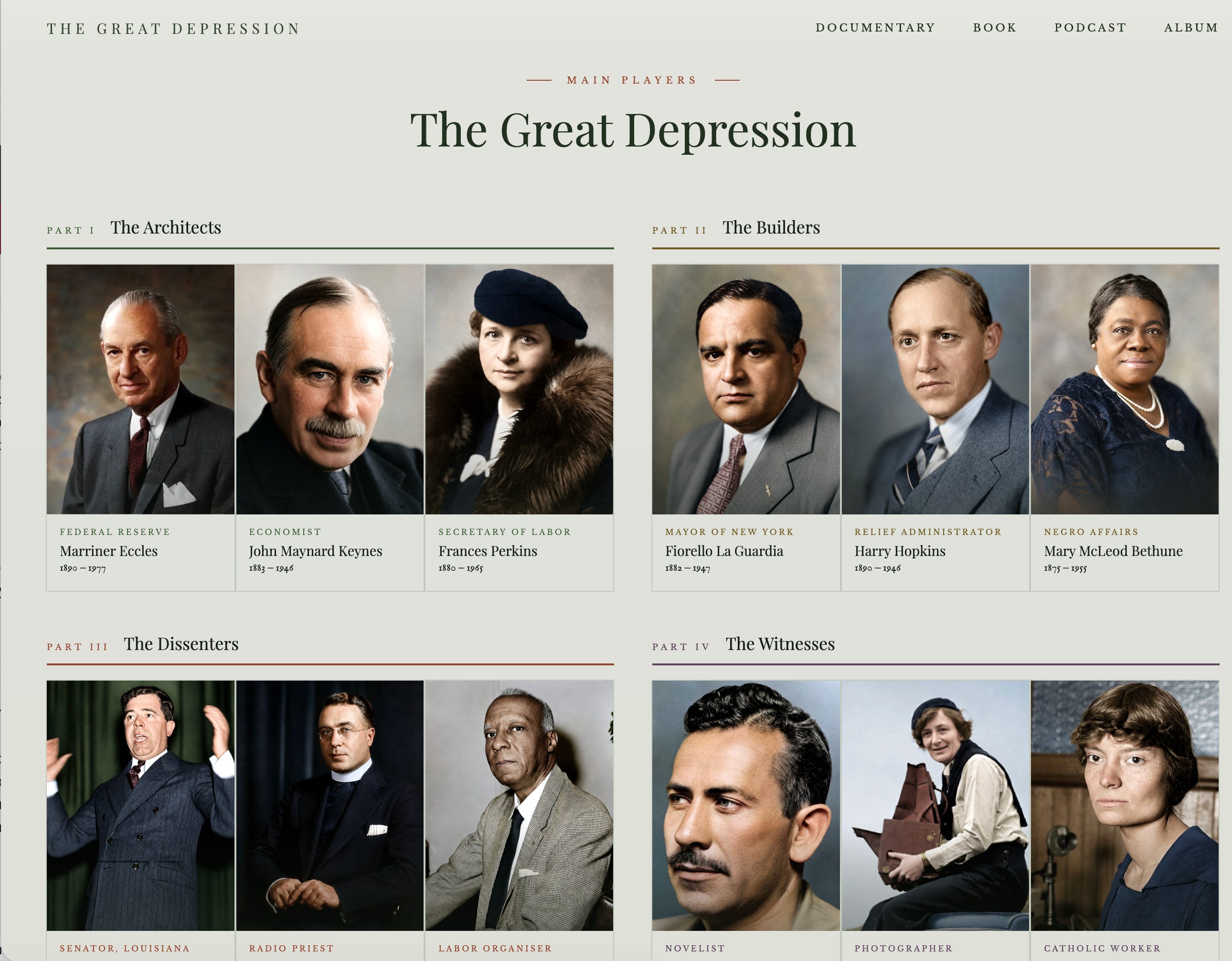
We’ve just completed a major new site design for GreatDepression.com, and I’m excited about what the project is becoming.
When we started working on GreatDepression.com, the idea was relatively straightforward: create a place to explore and preserve the history of one of the most consequential periods in American history. But the more we worked on it, the clearer it became that the Great Depression is simply too large a subject to tell through a single medium.
It deserves a book. It deserves a documentary. It deserves conversations with historians and economists. It deserves an archive of photographs, documents, recordings, music, speeches, and firsthand accounts. Most importantly, it deserves a place where all of those things can come together.
That is what we are trying to build with GreatDepression.com.
The redesigned site is intended to become the digital home for a much larger historical preservation and education project. Some parts are already taking shape, while others will continue to grow substantially over the coming months and years.
Here is a look at the major sections of the new site and what we hope to accomplish with each one.
THE GREAT DEPRESSION
At the center of the project is the history itself.
The Great Depression wasn’t a single event. It was an extraordinary convergence of financial, economic, political, technological, agricultural, and social forces that transformed the United States and much of the world.
The stock market crash of 1929 is the moment most people immediately associate with the Depression, but the story is much larger. Bank failures wiped out savings. Businesses disappeared. Industrial production collapsed. Farmers faced an agricultural crisis compounded by drought and the Dust Bowl. Unemployment reached levels almost unimaginable today. Families moved across the country looking for work and opportunity.
At the same time, Americans were engaged in an enormous debate over what government should—and should not—do in response.
GreatDepression.com is designed to help visitors understand that broader story: what caused the Depression, how it spread, how Americans experienced it, how policymakers responded, and how the country ultimately emerged from it.
We also want to explore the debates that remain unsettled. History becomes much more interesting when it is presented not simply as a collection of facts, but as an ongoing conversation about why events happened and what they mean.
THE DOCUMENTARY
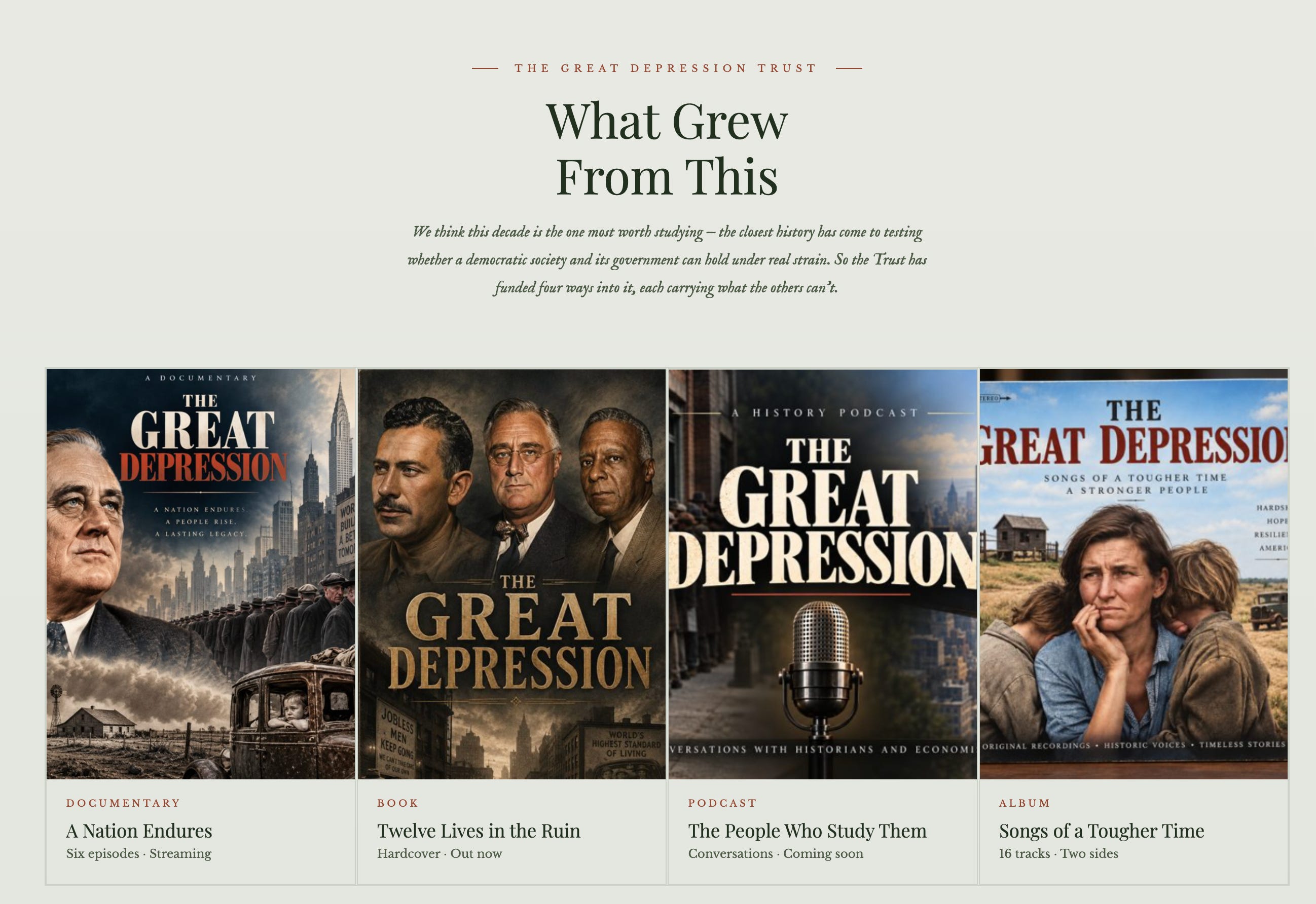
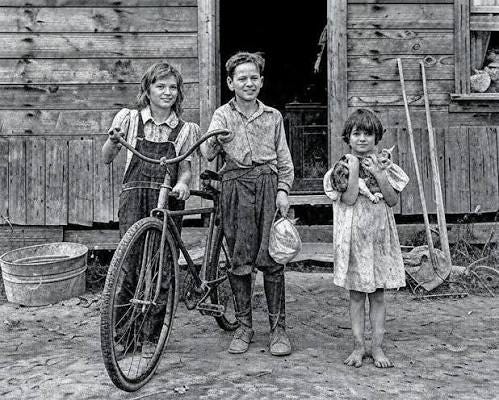
The Great Depression is also an extraordinarily visual period of history.
Some of the most recognizable photographs in American history came from this era. Newsreels captured presidents, breadlines, factories, protests, construction projects, farms, cities, migrant families, and the changing American landscape.
That makes documentary film a natural extension of the project.
Our documentary effort will combine archival photographs and footage with historical documents, recordings, expert interviews, and storytelling.
There is something fundamentally different about seeing the faces of people who lived through the Depression, hearing voices from the period, or watching historical footage of events that otherwise exist only as paragraphs in a textbook.
The documentary gives us an opportunity to make that history feel immediate again.
THE BOOK
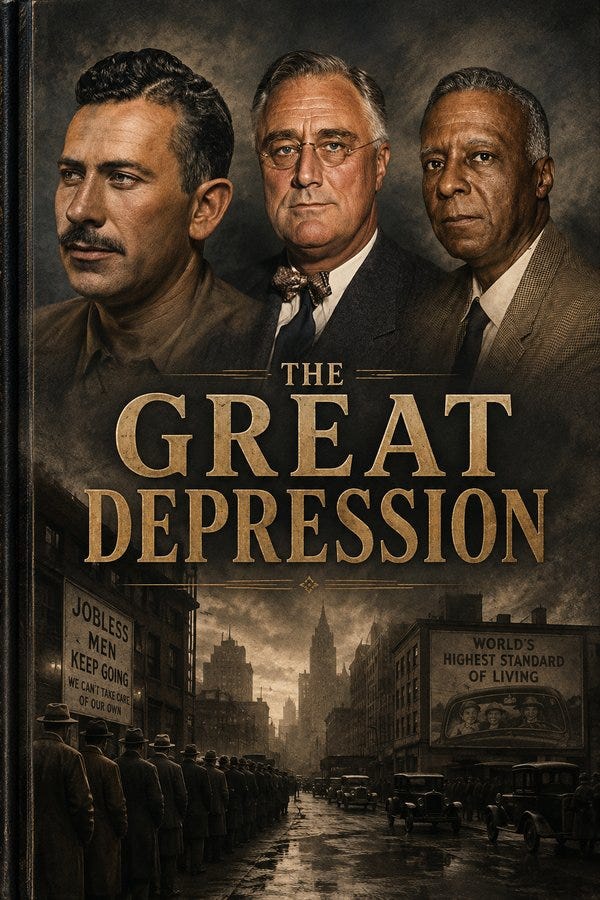
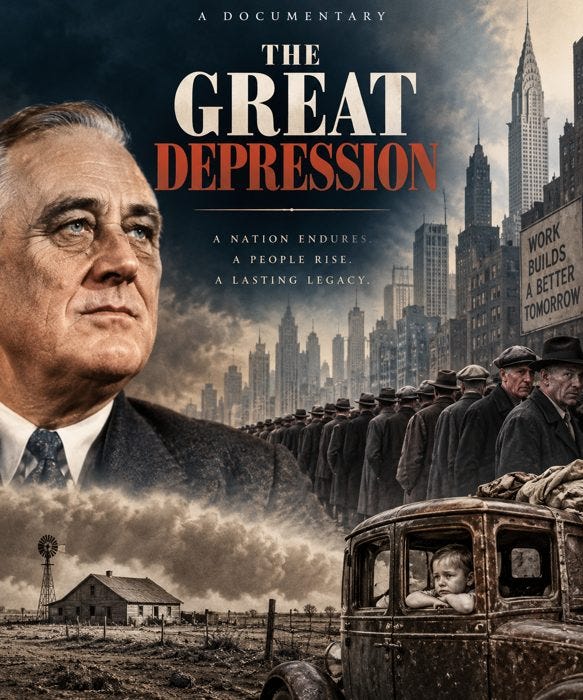
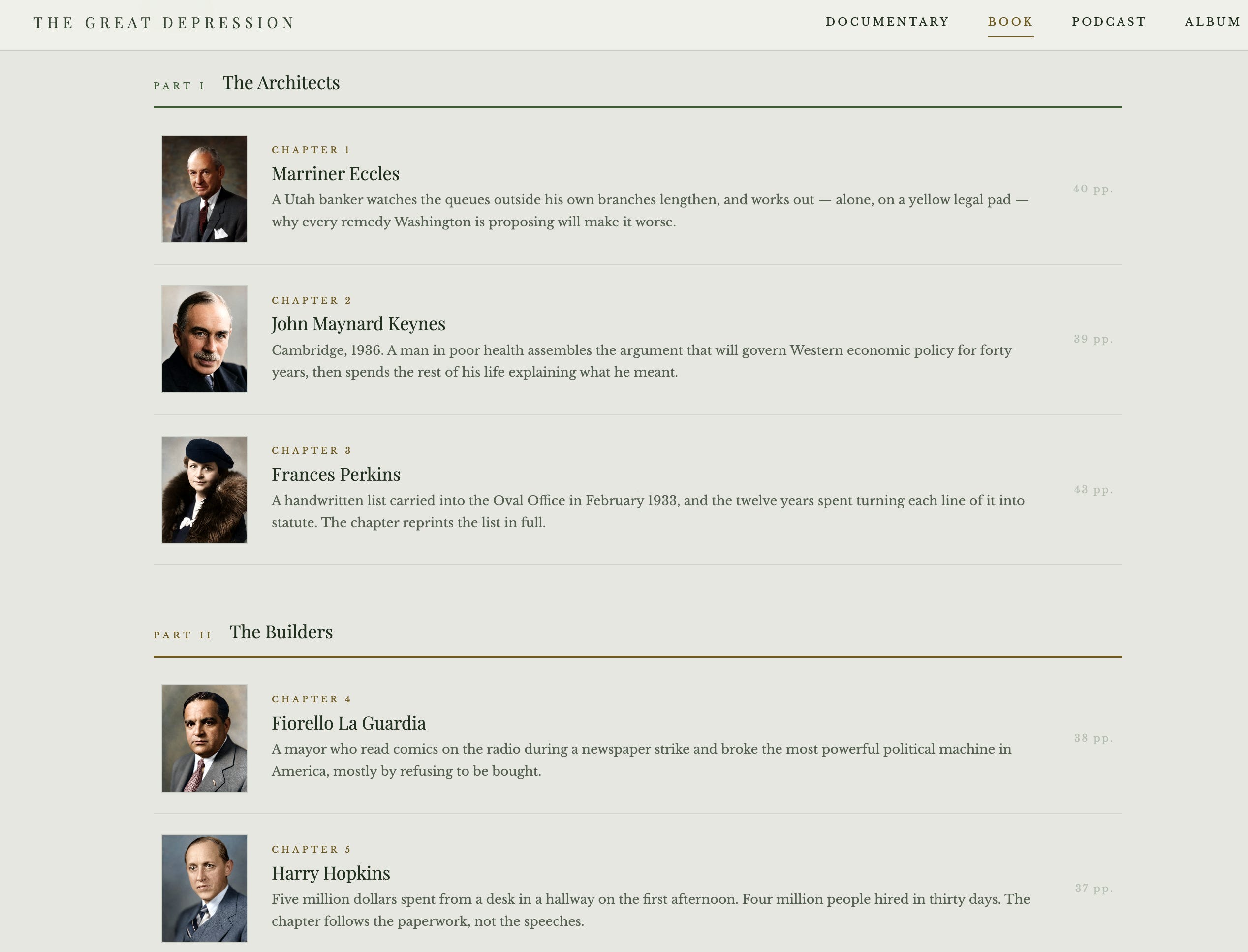
One of the central pieces of the project is a book about the Great Depression.
The ambition is to tell the story in a way that combines economic and political history with the experiences of the people who actually lived through it.
There are extraordinary personalities throughout this period: presidents, policymakers, economists, bankers, industrialists, labor leaders, journalists, photographers, artists, writers, farmers, business owners, and ordinary Americans trying to navigate circumstances they could never have anticipated.
We want the book to connect those individual stories to the larger forces transforming the country.
What did people believe was happening in 1929? When did Americans realize this was something more serious than an ordinary recession? What decisions made the crisis worse? Which policies helped? Which policies failed? How did people’s attitudes toward banks, markets, business, government, and economic security change?
Those questions are just as interesting as the statistics.
THE PODCAST
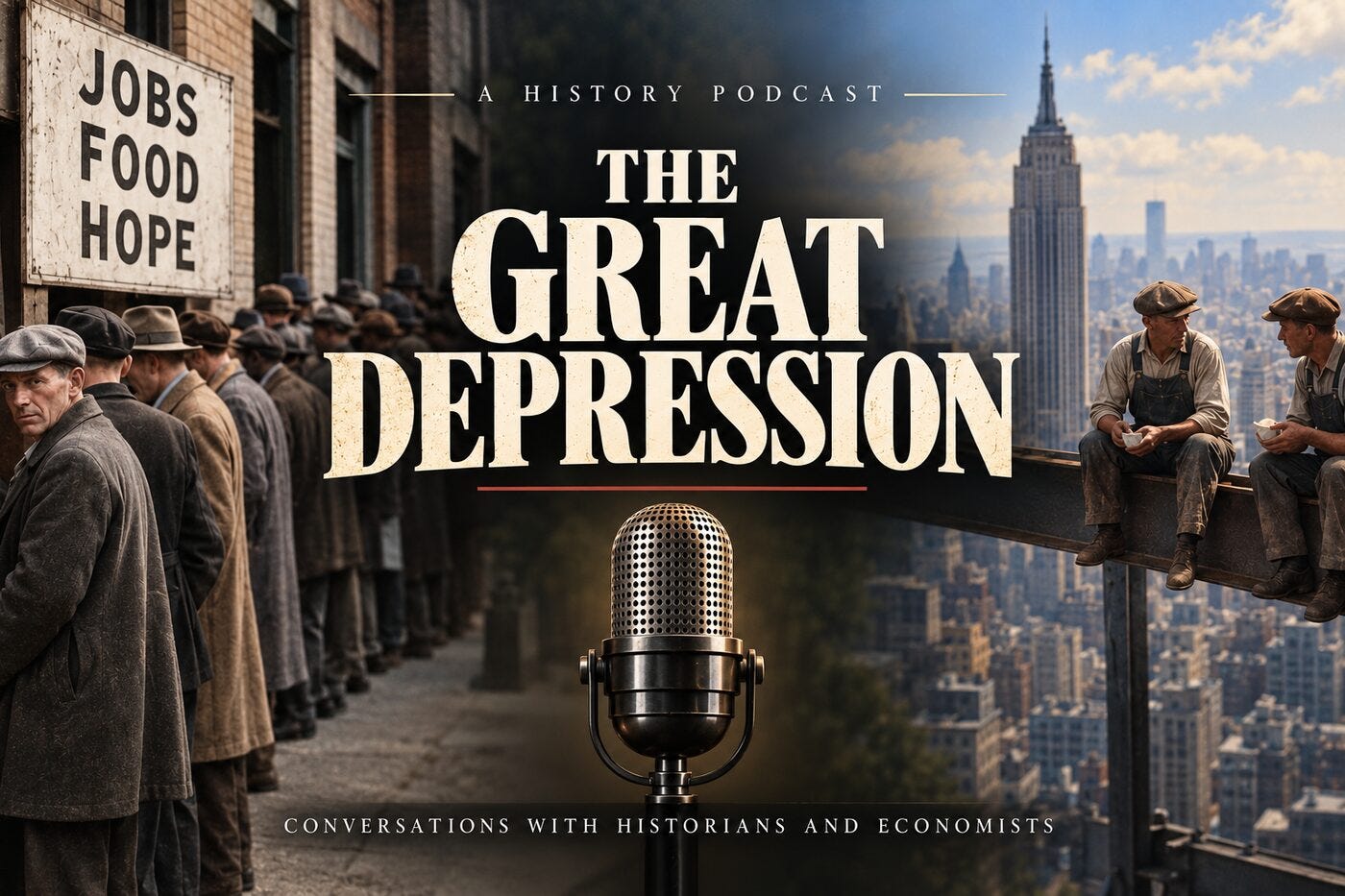
Another major component of GreatDepression.com is our podcast and interview series.
No single person can master every dimension of a subject this large. Historians may spend decades studying one administration, institution, industry, geographic region, or individual.
Economists continue debating monetary policy, fiscal policy, banking, international trade, and the causes and duration of the Depression. Biographers have devoted entire careers to figures such as Franklin Roosevelt, Herbert Hoover, Eleanor Roosevelt, and the policymakers surrounding them.
The podcast allows us to bring those experts directly into the project.
We want to sit down with historians, economists, authors, researchers, archivists, descendants, and others with unique perspectives and ask substantive questions.
Sometimes those conversations will focus on major historical questions. Other times they may focus on something surprisingly specific—a particular person, town, photograph, government program, business, song, or document.
Together, those conversations can create an oral library of expertise surrounding the Great Depression.
MUSIC & HISTORIC RECORDINGS
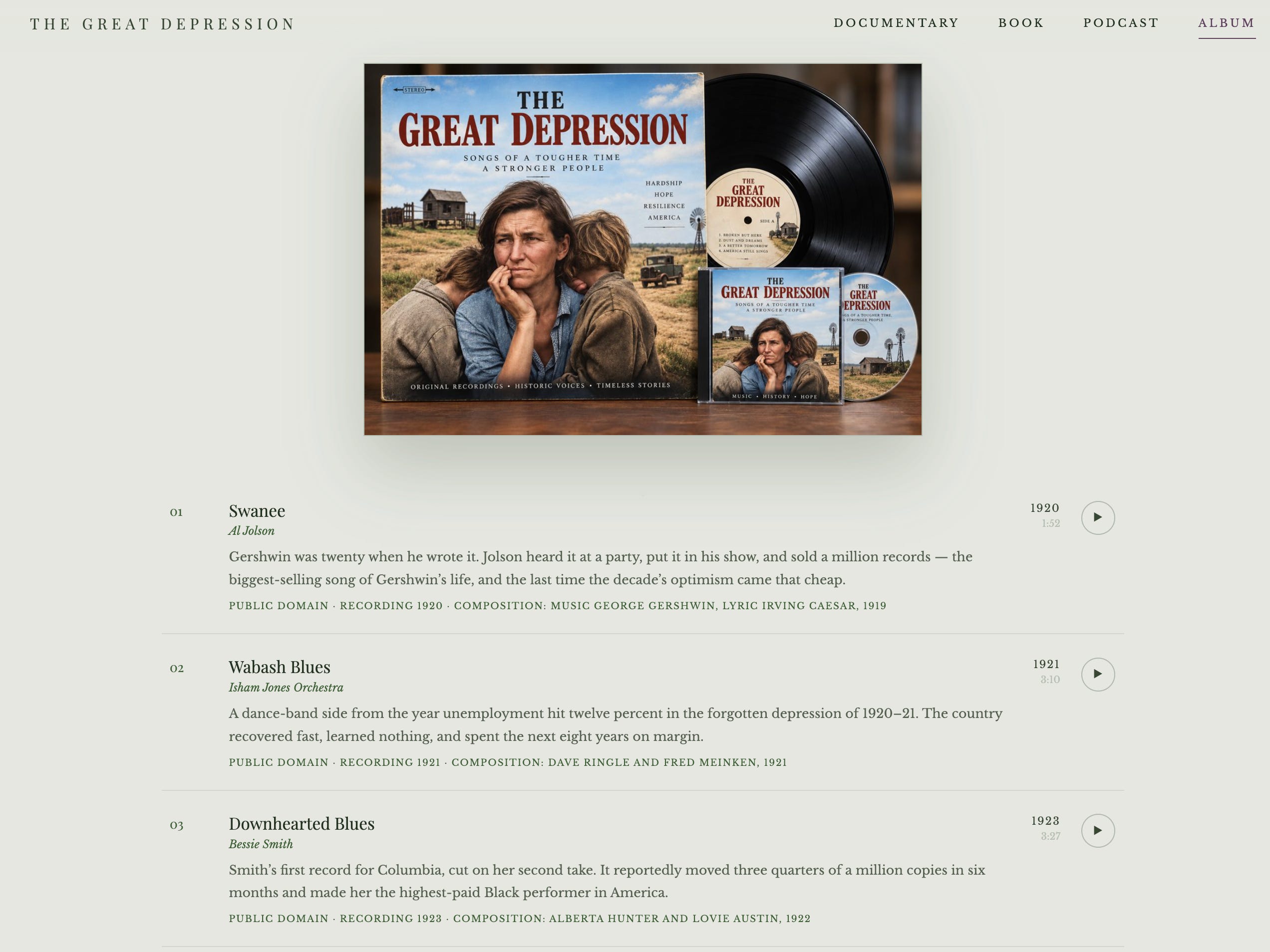
One of my favorite parts of the project is the effort to incorporate historic music and recordings.
History is usually presented visually and through written text, but sound can create an entirely different connection to the past.
Music tells us what people laughed about, worried about, danced to, sang along with, and listened to at home. Recorded speeches and broadcasts allow us to hear the cadence and emotion of people speaking during the period rather than simply reading their words decades later.
Our music and recordings section is designed to give visitors another way to experience the cultural environment surrounding the Depression.
As the collection grows, we hope it becomes almost a soundtrack to the history presented elsewhere on the site.
THE ARCHIVE
Preservation is one of the most important long-term goals of GreatDepression.com.
There is an enormous amount of material related to the Depression scattered across libraries, government collections, museums, universities, historical societies, private collections, family archives, and digital repositories.
We want to help bring that material together.
The archive will include photographs, documents, newspapers, letters, speeches, government publications, recordings, films, maps, advertisements, and other primary-source materials.
Primary sources have a special power because they allow people to encounter history without someone else completely interpreting it first.
A government report tells you what policymakers knew at a particular moment. A newspaper shows how events were being understood as they happened. A photograph captures details no written description could reproduce. A personal letter may reveal how a national economic crisis affected one family.
Over time, our hope is that the archive becomes one of the most useful components of the entire project.
PEOPLE & STORIES
The numbers surrounding the Great Depression are staggering, but numbers can also make history feel abstract.
Behind every unemployment statistic was someone who lost a job.
Behind every failed bank were families and businesses that had trusted that institution with their money.
Behind migration statistics were people packing their belongings and leaving communities they had known for generations.
Behind every government program were individuals whose lives were affected by it.
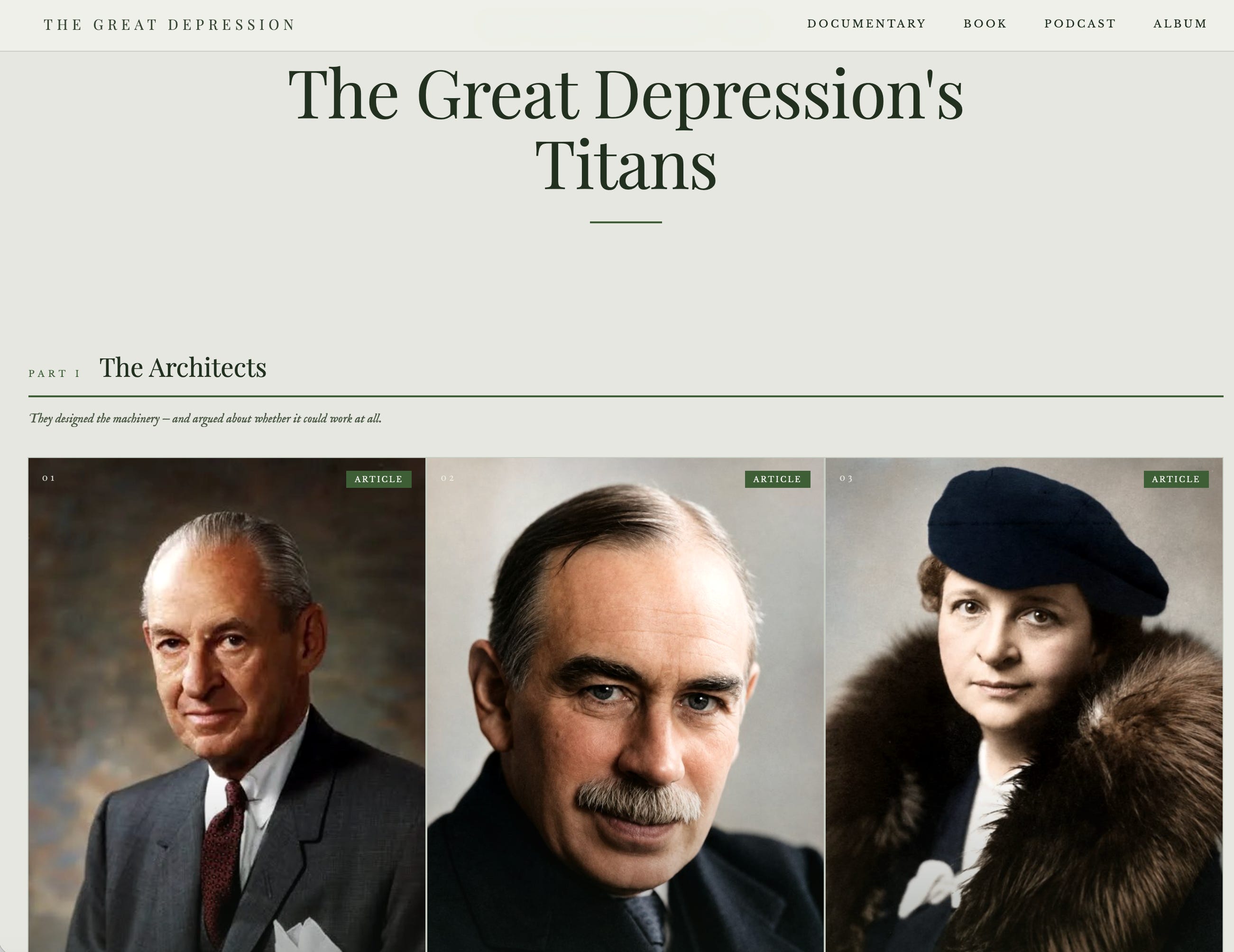
The People & Stories section is intended to keep that human dimension at the center of the project.
We want to profile both the famous figures who shaped the period and the ordinary Americans who experienced it.
Political leaders matter. Economists matter. Bankers and business leaders matter. But so do teachers, farmers, factory workers, shopkeepers, children, immigrants, veterans, artists, and families.
Their experiences are what turn economic history into human history.
POLICY, ECONOMICS & RESEARCH
The Great Depression also remains one of the most studied economic events in history.
Nearly a century later, economists and historians still debate its causes, the effectiveness of the New Deal, the role of the Federal Reserve, monetary policy, fiscal stimulus, tariffs, banking regulation, international finance, and what ultimately ended the Depression.
Those debates aren’t merely academic.
Modern policymakers continue to study the Great Depression when confronting financial crises, bank failures, recessions, unemployment, deflation, and systemic economic risk.
This part of the site will examine competing interpretations rather than pretending that every historical question has a simple answer.
Where scholars disagree, we want visitors to understand why.
THEN AND NOW
One of the most interesting questions surrounding history is what it can teach us about the present.
The world of the 1930s was obviously very different from the world of today. Financial markets have changed. Banking has changed. Government has changed. Technology has changed. The global economy has changed.
But human behavior hasn’t changed nearly as much.
Fear, speculation, leverage, optimism, panic, political disagreement, technological disruption, inequality, migration, and debates about government’s role in the economy remain familiar.
We want GreatDepression.com to provide historical context without forcing simplistic comparisons.
History rarely repeats itself perfectly. But understanding how people and institutions responded to previous crises can make us better equipped to think about our own.
BUILDING A LONG-TERM HISTORICAL RESOURCE
Ultimately, the redesigned GreatDepression.com is only the foundation.
The larger vision is to build an enduring historical resource around this period.
That means continuing to find photographs and documents. It means recording interviews with experts. It means finding people with family stories and collections that might otherwise disappear. It means producing the book and documentary. It means expanding the podcast. It means organizing primary sources so students and researchers can actually use them.
And it means treating preservation as an ongoing process rather than a finished product.
Nearly a century now separates us from the beginning of the Great Depression. The number of people with direct memories of the period has declined dramatically, and even the stories passed from parents and grandparents to subsequent generations can disappear surprisingly quickly.
Documents get thrown away. Photographs lose their identifying information. Recordings deteriorate. Family stories fade.
Digital preservation gives us an opportunity to save some of that history and make it available to an audience far larger than would ever be able to visit a physical archive.
That is the larger mission behind this project.
WHAT COMES NEXT
There is still an enormous amount of work ahead.
In many ways, that is what makes the project exciting.
GreatDepression.com can continue growing as new research, interviews, photographs, recordings, documents, and stories are added.
We’re particularly interested in connecting with historians, economists, universities, museums, historical societies, collectors, researchers, authors, archivists, and families who may have relevant material or expertise.
If you have photographs, letters, documents, recordings, family stories, research, or another connection to the Great Depression, we would like to hear from you.
If you’ve written a book or conducted research about the period, we’d like to know about it.
If there is someone we should interview, tell us.
If there is a collection we should know about, point us toward it.
The goal isn’t simply to tell people what happened.
It is to preserve the evidence, collect the stories, bring together expertise, and make the history accessible to anyone who wants to understand it.
A book can tell one version of the story.
A documentary can show another.
A podcast can explore questions in depth.
An archive can preserve the original evidence.
GreatDepression.com can bring all of those things together.
The redesigned site is now live.
Explore the project at GreatDepression.com.